


Sparkling wine from our own soil
On the slopes of Limburg's Louwberg stands the oldest professional winery in the Netherlands. Apostelhoeve's wines even managed to impress a French president.
First the bad news: the Apostelhoeve's sparkling wine, soft bubbles from its own soil, is sold out. All other wine from vintage 2020 too, for that matter. Those who are lucky might still be able to score a bottle on the internet, but anyone who wants to serve a Riesling Brut or a Cuvée XII Brut from the Netherlands' oldest professional wine company for New Year's Eve in a year's time had better register today.
In about three months' time, the 2021 harvest will be bottled and that too is likely to sell out real quick too.
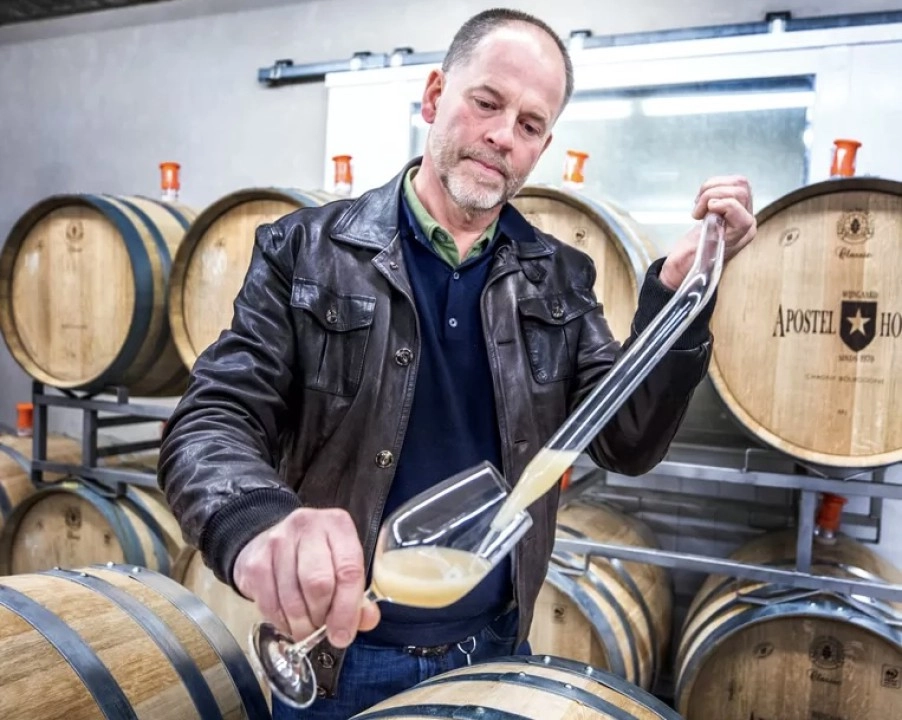
In the cellars of the winery on Limburg's Louwberg, the wine ages in steel barrels; a small amount lies on French oak. Eight varieties of white, including two sparkling, which can be served in the year after the harvest. ‘Here, nature quietly does its work,’ says owner Mathieu Hulst (55) between the barrels, ‘steering the quality is mainly done in the vineyards.’
Light tingle
The vineyards are rolling from the monumental, marlstone farmhouse towards the Jeker valley - a lost piece of France between Maastricht and Belgium. Here, father Hugo Hulst planted a parcel of vines among his apple and pear trees in 1970 to bottle the first 1,700 bottles four years later. Fine terroir, as it turned out. The local Marl consists mainly of carbonated limestone that gives the wine a bit of bite, a very slight tingle.
Over 50 years later, production of the now eight varieties of white is at over 100 thousand bottles, wines from the Apostelhoeve have won international awards, and Mathieu is ready to expand from 14 to 19 hectares in April 2022. His sons Robin and Gilbert, in their twenties, have now joined the family business. ‘We hope to produce 200 thousand bottles in four years’ time.'
Scaling up doesn't happen overnight in winemaking - it's slow business. Only four years after planting new vines can the first wine be bottled. ‘The cash flow is corresponding,’ says Mathieu. 'We necessarily want to keep the financing in our own hands. Then it will take a bit longer: it will go our way. If you want to establish something good in winemaking, you have to think in generations rather than years.'
While father Hugo started with an old wine press from a local cabinetmaker, son Mathieu - who stepped in in 1985 - led the company into mechanised operations in the 21st century. For six years, harvesting has been done by machine. With a harvesting machine that very gently unrills the ripe grapes, Mathieu ‘picks’ in an hour and a half the quantity that 25 pickers had a day's work for. Until last year, the Hulst family still bottled everything themselves, in 2020 a professional bottler was brought in to work 30 thousand bottles a day under the cork.
The pioneering blood remains. As the first commercial wine estate in the Netherlands, the Apostelhoeve planted viognier grapes in 2020, alongside müller-thurgau, riesling, auxerrois and pinot gris. The grape variety, known from the northern Rhône region, is making an international breakthrough.It remains a gamble whether the delicate, southern viognier will feel at home on the Limburg slopes.
Unrequested compliment
Mr Hulst is responding to global warming with those plantings, and it is going fast, he says. 'From 1985 we noticed that the weather was changing permanently. We used to try to catch every ray of sunshine. After all, too little sun produces acidic wine. Now, on the other hand, we have to harvest earlier to keep enough acid. We used to never pick before 10 October, while now we are as early as 10 September.’
It remains an unsure sector, he says. Last April, late night frosts cost him about 30 per cent of the harvest. Like many French winemakers, the Hulst family placed wax pots between the vines for two freezing nights to temper the cold, a huge cost. He therefore sometimes slows his boys down a little in their enthusiastic plans for the business. ‘Slow down, I then say, first see what the new parcel brings in - we only have insurance in the cellars for one year.’
The Apostelhoeve doesn't do much marketing. After all, good wine does not need a crown, especially when it is on the menu of Michelin-starred restaurants and receives an unrequested compliment from a French president. Thirty years ago, at a dinner in the Limburg capital on the eve of the Euro summit that would lead to the Maastricht Agreement, an auxerrois was poured from the Apostelhoeve. Much to the delight of French president Francois Mitterrand. 'Years later, his widow came by. She told how impressed her husband was by our wine.’
Last year, three Apostelhoeve wines were awarded gold at a prestigious wine competition in Strasbourg. The vinological knowledge underpinning the top wines grew at the Apostelhoeve. ‘We discuss everything with eachother, with my father, my wife, my sons and I,’ says Mathieu. 'And when we taste a new blend, grandma joins us. Most votes count then. We don't always agree, but it's always fun.'